
|
November 16, 2001Alvarion and Opto 22 Come Together at BextToo bad you missed this informative talk on remote control and monitoring by TCP/IP. Factory rep Scott Winterrowd (swinterrowd@opto22.com) showed us how far the Opto-22 line has advanced. The beauty of what Opto-22 now offers compared to an all-in-one typical broadcast remote control system is flexibility. You can mix and match I/O module types on each chassis to monitor and control an astounding variety of signals. Each chassis has its own controller that acts as a monitor that alerts you when your chosen signal is out of tolerance or simply changes state: your tower light is out, your transmitter is drifting, your MC operator has fallen asleep (if only it could). Typical communication is by TCP/IP on Ethernet. It can send you an email, or send an SNMP trap, etc. It can serve as a controller as a result of this occurrence. Each has a built-in HTTP Server (a web server!) and can alternately interface via a built-in serial port then connect to a cell phone. Opto makes a special package for tower sites. They even sell their own industrial strength solenoid latch for granting remote access to a compound. The GUI interface is programmable for those who want to take the time to design really cool buttons and graphics or it can be set up using ROE (regular old English). Scott sez the newer Ultimate I/O line is even more programmable. For a real time demo via their integrated HTTP servers, visit http://www.internetio.com/default.shtml where you can see and control things via the Internet and can see the results of your actions.
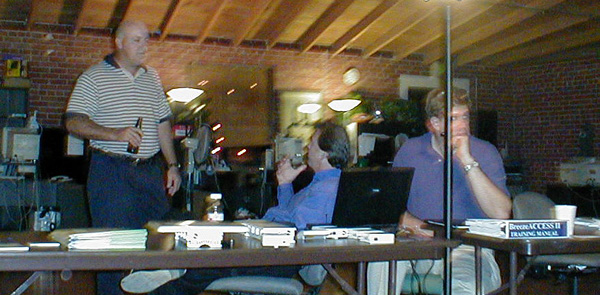
Scott, Andrew and Phil Relax Pre-meeting in Bext's Upstairs FacilityFormerly BreezeCom, Alvarion manufactures the BreeseCOM line of wireless broadcast equipment. Andrew Read (andrew.read@alvarion.com) showed us the BreezeAccess and BreeseNET. The BreezeAccessII line of 802.11 wireless Ethernet gear uses Frequency Hopping Spread Spectrum in the license-free 2.4GHz ISM band. Real world throughput is the 1.0 to 1.5Mb/s range and when optimized point to point has been quite reliable to as much as12 miles. (The system drops to .5 Mb/s under poor signal or heavy interference situations in order to maintain a connection.) This line of radios is much more robust than typical "workgroup quality" radios in bad environments. The line allows you to restrict data rates by subscriber unit so you can control bandwidth use. Since a typical DSL circuit and ANY T-1 circuit operates in the 1.5 Mb/s range, this product becomes a great way to provide Internet access when running a line is not an option or an extra expense for a single connection. (North American sales and service headquarters is in Carlsbad ! !) A special version of this line of radios has a POTS jack on it and provides ring voltage, battery, and dial tone; a phone on any subscriber unit can call a phone on any other subscriber unit in the system using DTMF. The BreezeNET line uses DSSS and 802.11(b) standards for real world throughput around 5.5 Mb/s for a wireless replacement or addition to a 10Mb ethernet LAN. It can be used to connect various locations in a multipoint remote broadcast, to connect van or truck to a reporter's laptop (and maybe even hop the data back to the studio LAN), or around the studio where people are moving around a lot. Going to the transmitter might be a better job for the BreezeAccessII line; the BreezeNet has a more signal but the BreezeAccessII line handles interference better. Both lines typically have between 3 and 10 dbm more output than lower end gear and have better receivers. Alvarion also provides a whole line of omni and directional antennas. www.breezecom.com And the reason that Phil Wells of Giant Step Communications brought these two together for this meeting? "We expect to have an Opto-22 chassis talking to a laptop via a BreezeCom Access Point and Subscriber Unit very soon." Imagine the possibilities of a close watch on ALL of those pesky signals. (sales@giantstep.biz).
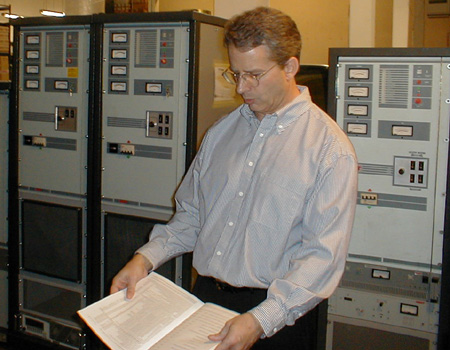
Anders Madsen Looks Up a Spec for a Member QuestionNot to forget the sponsors, BEXT has been selling FM transmitters, translators, antennas and STL gear since Dennis Pieri started the company in 1985. These guys have been a great local supporter and hosted a number of SBE meetings in the past in their beautiful downtown building. They are the largest of the independent transmitter providers and sell to the entire world.
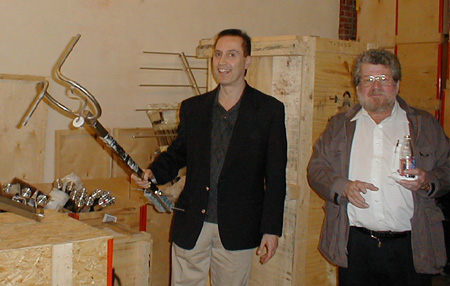
Dennis Pieri Takes an Antennae Out of Storage for ShowThey had some new stuff on display that you probably have not have seen like DAB transmitters and TV transmitters (even a Digital one); the XPT series of exciters with AES/EBU digital inputs; the extremely cool XL1000 which is a KILOWATT in a 3U rack. On the other end of the spectrum [pun intended] the portable, frequency agile, 10 watt FM transmitter with XLR inut made at least one at the meeting take a second look. (www.bext.com) |
||